
Your CRM calendar wasn't built for your customers
Your CRM is the one relationship in your customer's life that only talks on Tuesdays. · Zelara Team · 13 Nov 2026 · 5 min read

Your friends text when something happens. Your bank pings you when money moves. And then there's the brand you bought running shoes from, which shows up every Tuesday at 10:00 whether you've been on their site three times this week or not at all since March.
Nobody on the receiving end asked for that rhythm. Marketers built it. And if you work in a lifecycle, you probably built one too.
Open your CRM calendar
Think about it for a second. Most lifecycle calendars look roughly the same. A newsletter on Tuesday. A promo on Thursday. Something on Sunday morning, because someone once saw a lift and nobody has touched it since. Around that sit the onboarding flow, a win-back series and the occasional launch that pushes everything else back a week.
It looks like a strategy. It has colors, owners and a quarterly view. But ask why the newsletter goes out on Tuesday and the honest answer is rarely about the customer. It's because the copy gets approved on Monday.
Why the grid exists
It comes down to what it takes to get a single message out the door.
Someone writes the copy. Someone reviews it for brand, then legal, then the marketing lead who wants one line changed. Design builds the template. Someone sets up the audience, checks the links, tests the rendering and schedules it. Now multiply that by every message, every market and every language.
A fixed calendar is how a team of five survives that. It batches the work into something people can plan around. It keeps reporting clean, because this week compares neatly to last week. It gives stakeholders a slot to fight over instead of an open inbox.
None of that is a bad decision. It's a reasonable answer to a capacity problem. Somewhere along the way, though, we started describing the capacity answer as a customer strategy.
Personalization, mostly
When teams want to do better, the usual move is to personalize. In practice that often means the same grid with more rows. The newsletter now goes to six segments instead of one. The subject line has a first name in it. A product block changes based on the last category someone browsed.
That's real work, and some of it helps. Send time optimization goes further and moves the email from 10:00 to 19:40 for people who tend to open in the evening. Useful. But it's still Tuesday, and it's still everyone. The timing, the frequency and the decision to send at all are set by the calendar, not by anything the customer did.
The campaign that won
There's a quieter side effect. When every message is expensive, you only ever compare a few of them. Two subject lines, maybe three creatives. A winner gets picked, rolled out to everyone and becomes the template for next quarter.
Your best campaign didn't win because it was good. It won because it was the only one you had time to send.
So the grid doesn't only decide when you talk to customers. It decides how much you can learn about them: a handful of tests a month, each read weeks later, each averaged across thousands of people who wanted different things.
The bottleneck is moving
That constraint, people building every message by hand, is starting to go away. Content can be created in many variations instead of two. Decisions about who hears what, and when, can be made for each customer based on how they actually respond. And learning doesn't have to wait for a quarterly readout. Each interaction informs the next one, which is where the gains start to compound.
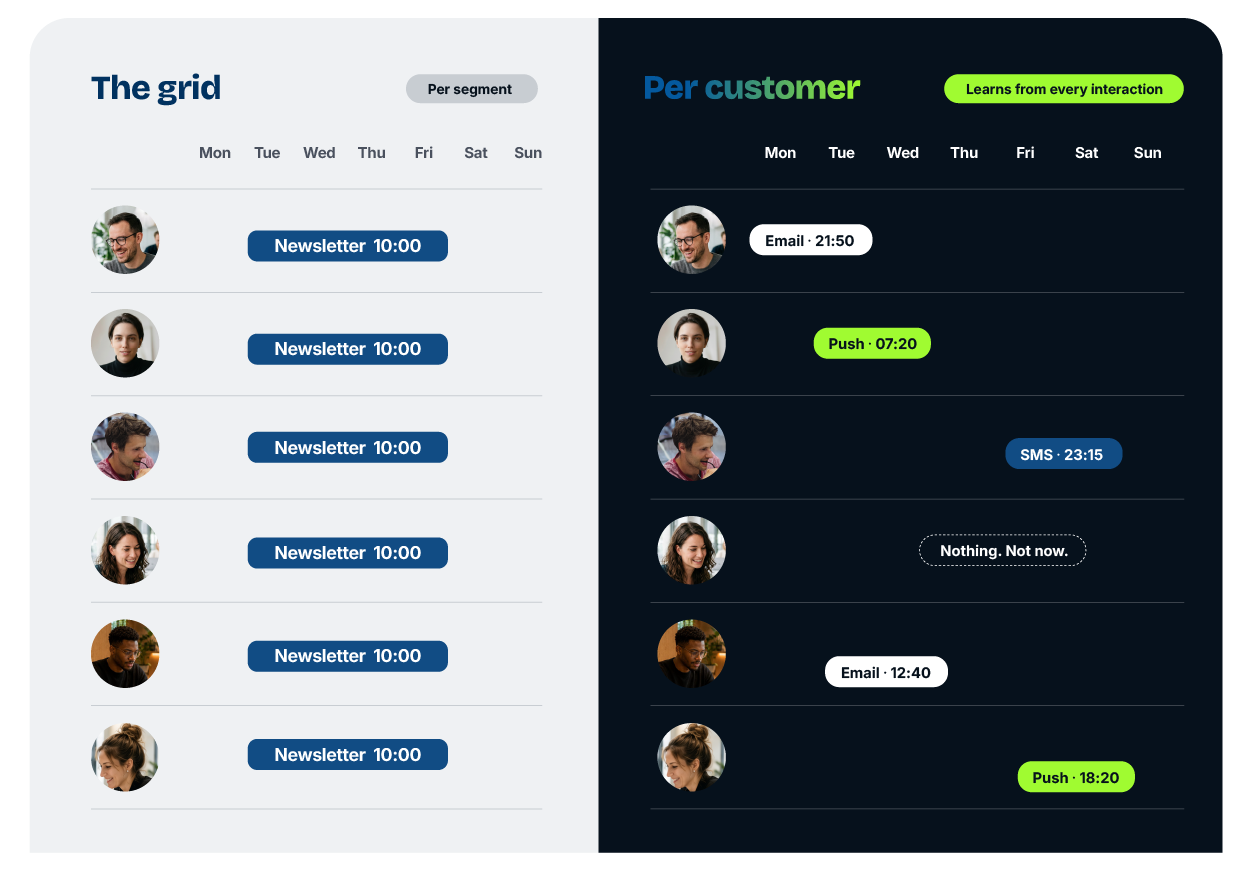
The question changes with it. Less "what do we send on Tuesday?" and more "what should this person hear next, if anything?"
This doesn't take the team out of the picture. Someone still decides what the brand stands for, which outcomes matter, what's off-limits and what a good customer relationship looks like. Those decisions just stop being buried under production work.
So, what would you stop doing?
Here's what we keep asking lifecycle teams:
If you could talk to every customer at the right moment, with something that was actually about them, what would you stop doing tomorrow?
Maybe it's the Monday approval scramble. Maybe the Sunday send nobody can justify anymore. Maybe the segmentation sheet with more tabs than anyone can name. The answer usually comes fast, which says a lot about how much of the calendar is there for us, not for them.
We're building Zelara around that question: a learning layer on top of the CRM you already use, getting better with every interaction. But it's worth sitting with either way.